Float Play in Poker: How to Win Pots You Missed by Calling Now and Attacking Later
Floating is calling a flop bet with a weak hand — not to hit a draw, but to take the pot away on a later street when your opponent gives up. It’s one of the most profitable post-flop moves when used correctly, but it requires position, the right board texture, and the right opponent. Miss any of those conditions and you’re just burning chips.
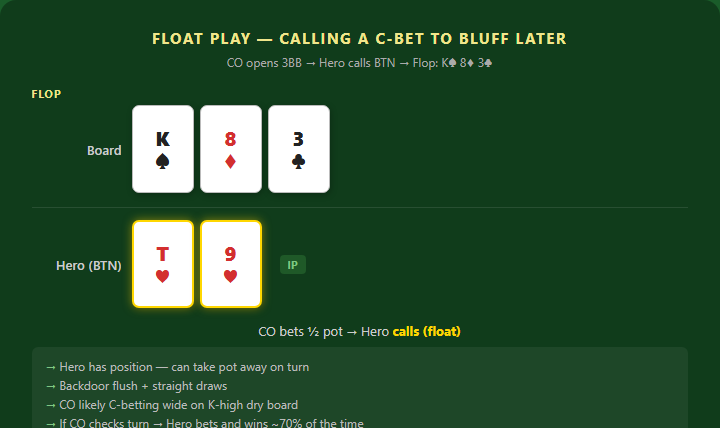
The first time I successfully floated was at NL100. I was on the button with T♥9♥, the CO opened, and the flop came K♠8♦3♣. I’d whiffed completely — no pair, no draw, nothing. The CO fired a half-pot C-bet. Old me would have snap-folded. But I’d just been reading about float plays, so I called.
Turn: 2♠. He checked. I bet two-thirds pot. He folded instantly. And just like that, I won a pot I had absolutely no business winning. That’s when floating clicked for me: you’re not calling to hit your hand — you’re calling to wait for your opponent to give up.
What Is a Float Play?
A float is simple in concept: you call a flop bet with a weak or worthless hand, planning to take the pot away on the turn (or river) when your opponent checks.
The key distinction is intent. Here’s how floating compares to other post-flop moves:
Float vs Standard Call vs Semi-Bluff
| Play | Hand Strength | Why You Call | Profit Source |
|---|---|---|---|
| Standard call | Medium (e.g., middle pair) | Showdown value | Pot equity |
| Semi-bluff | Draw (e.g., flush draw) | Raise to pressure + hit | Fold equity + pot equity |
| Float | Weak or nothing | Steal pot on later street | Delayed fold equity |
Floating is essentially a delayed bluff. You don’t bluff the flop (because your opponent just bet, signaling interest in the pot). Instead, you wait for the turn — and when they check (signaling their interest has faded), you strike.
Four Requirements for a Profitable Float
Not every missed flop is a float opportunity. I wasted a lot of money learning these four conditions the hard way — every single one must be present.
Requirement 1: You Must Have Position
This is the non-negotiable rule of floating. No exceptions.
The entire float concept depends on seeing your opponent’s turn action before you decide. In position (IP), your opponent acts first on the turn — if they check, they’ve shown weakness, and you pounce. Out of position (OOP), you act first. You have no information. You’re guessing.
I’ve seen players try to float from the big blind. It almost never works. You call the flop C-bet, the turn comes, and now what? Bet as a bluff (and maybe get raised)? Check and face another bet? Either way, you’re playing blind.
Requirement 2: Your Opponent C-Bets Wide but Gives Up on the Turn
Floating makes money because your opponent bet the flop without a real hand and will abandon the pot on the turn. This assumption holds against:
- High C-bet frequency regs (>65%) — they’re betting the flop out of habit, not because they connected
- High turn give-up rate (>50%) — after getting called, they frequently check-fold the turn
This assumption fails against:
- Low C-bet regs (<45%) — they only bet when they have something. Your float runs into real hands.
- Double-barrelers — they fire the turn regardless. Your float plan dies on arrival.
- Calling stations — don’t float fish. They won’t fold the turn either.
Requirement 3: The Board Texture Doesn’t Favor Your Opponent
Floating works best on dry, low-to-medium flops — boards where it’s hard to make a strong hand.
Good boards for floating:
- K-8-3 rainbow — only KK/88/33 are monsters. Opponent likely has one K or air.
- T-6-2 two-tone — dry middle board, low pairing frequency.
- 7-4-2 rainbow — ultra-dry. Unless they have an overpair, they’re probably bluffing.
Bad boards for floating:
- A-K-Q — smashes the opener’s range. They likely have top pair or better.
- J-T-9 two-tone — wet and coordinated. Too many draws and made hands. Opponent won’t give up.
- Paired boards (e.g., 8-8-3) — if they have an 8, you’re drawing nearly dead.
Requirement 4: You Have Backdoor Equity (Optional But Ideal)
The best floats aren’t pure air — they come with backup plans:
- Backdoor flush draw — two suited hole cards with one matching suit on the flop. If the turn brings another, you have a real draw.
- Backdoor straight draw — connectors near the board cards. Gives you more confidence to barrel the turn.
- One overcard — like AJ on a T-7-3 flop. If you hit the A on the turn, you likely have the best hand.
These equity tails mean your float isn’t purely dependent on your opponent folding. Even if the steal fails, you might improve to the best hand.
Turn Strategy After Floating
The critical moment arrives on the turn — when your opponent checks.
Option 1: Bet to Steal (Default Play)
Your opponent’s check signals weakness. This is your cue. Standard sizing is 55-70% of the pot — small enough to limit your risk, large enough to apply real pressure.
If you’ve chosen the right spot (high C-bet opponent, dry board), this bet succeeds 60-75% of the time. That makes floating one of the most efficient ways to pick up pots post-flop.
Option 2: Check Behind (Special Cases)
Sometimes the turn brings a card that’s scary for you — like an ace on a K-8-3 flop. If that ace legitimately helps your opponent’s range, forcing a bet is risky. Check behind and take a free river card.
Or maybe the turn gives you a real draw (backdoor flush or straight completed). You can check to see a free river and potentially win a bigger pot if you hit.
When Your Opponent Doesn’t Check the Turn
This is the nightmare scenario — you floated the flop, and your opponent fires again on the turn (double barrel).
Most of the time: fold.
Your opponent betting both the flop and turn means their hand is stronger than you assumed. Your float was predicated on them giving up — if they don’t, the plan has failed. Continuing turns your low-risk float into a high-cost bluff, which is not what you signed up for.
The exception: if you picked up a real draw on the turn (like a flush draw), you now have a semi-bluff situation and can consider calling or raising. But with pure air facing a double barrel, get out cleanly.
Three Real Hand Examples
Hand 1: Textbook Successful Float
NL200 6-max. CO reg (VPIP 26/PFR 21/C-bet 72%) opens to 3BB. I call on the BTN with T♥9♥.
Flop: K♠8♦3♣. Opponent bets 4BB into a 7.5BB pot (~53% pot).
Analysis: Complete whiff. But every float condition is met: I have position, the board is dry (K-8-3 rainbow), his 72% C-bet frequency means he’s firing with a ton of air, and I have backdoor hearts plus a backdoor straight.
Action: Call (float). Turn: 2♠. Opponent checks. Perfect — the blank turn and his check confirm his flop C-bet was air. I bet 10BB into 15.5BB (~65% pot). He folds.
I won a 15.5BB pot with ten-high. That’s the float in action.
Hand 2: When You Should NOT Float
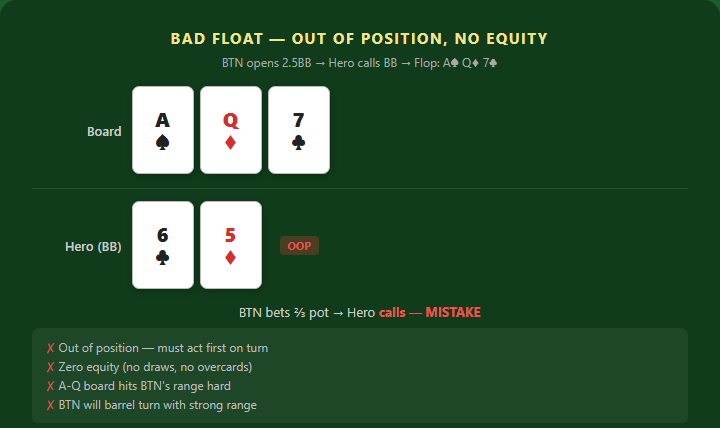
NL200 6-max. BTN opens to 2.5BB. I call in the BB with 6♣5♦.
Flop: A♠Q♦7♣. Opponent bets 4BB into a 6BB pot.
Why floating is wrong:
- I’m out of position — must act first on the turn.
- A-Q-7 absolutely crushes the opener’s range (AQ, AJ, AT, KQ, QJ all connected).
- My hand has zero equity — no backdoor draws, no overcards.
- Even if he checks the turn, I can’t be confident he’s weak — he might be trapping with top pair.
Correct play: Fold. Not a single float condition is met here.
Hand 3: Float That Develops Into a Real Hand
NL200 6-max. HJ opens to 3BB. I call in the CO with 8♠7♠.
Flop: K♣9♠4♠. Opponent bets 4BB.
Analysis: I don’t have a pair, but I have a flush draw (two spades in hand, one on board). This is a hybrid between a float and a semi-bluff — I’m calling partly to steal and partly because I have real equity (9 flush outs).
Action: Call. Turn: 3♠ — flush hits! Opponent bets 12BB. I raise to 30BB. He calls. River: J♦. He checks, I bet 40BB. He calls. I scoop a 120BB+ pot.
This is why floats with backdoor equity are the best — even when the steal plan isn’t needed, you can win monster pots by improving.
Common Float Mistakes I See at Low and Mid Stakes
After reviewing thousands of hands — mine and others’ — certain float mistakes come up over and over. Here are the top three that cost the most money.
Mistake 1: Floating Without a Plan for the Turn
Too many players call the flop “to see what happens.” That’s not floating — that’s calling and hoping. A real float has a specific plan: “If he checks the turn, I bet 60% pot. If he bets again, I fold.” If you can’t articulate your turn plan before you click call on the flop, you’re not floating — you’re gambling.
Mistake 2: Floating Multi-Way Pots
Floating works because you’re heads-up against one player who probably has air. In a multi-way pot (three or more players), the chance that at least one opponent has a real hand goes up dramatically. Floating into two opponents is like bluffing into two opponents — the math almost never works. Keep your floats heads-up only.
Mistake 3: Floating the Same Opponent Too Often
If you float the same reg three times in a session, they’ll figure out what you’re doing. Your turn bets will start getting check-raised, and your “low-risk” floats will turn into expensive disasters. Float selectively — once or twice per session against the same opponent is plenty. Mix in some legitimate calls with real hands so they can’t profile you as a serial floater.
The thread connecting all three mistakes is the same: treating floating as a default move rather than a selective, conditional play. Float when the conditions are right. The rest of the time, just fold your air — there’s no shame in it.
How Floating Connects to C-Bet Strategy
Floating is fundamentally a counter-strategy to continuation betting. If you understand that most openers C-bet the flop habitually — even when they’ve missed — then floating is the weapon that exploits that habit.
The flip side: if you’re the one C-betting a lot, you need to realize that experienced opponents will float you. Two defenses:
- Lower your C-bet frequency — don’t auto-bet every flop. Only C-bet when you have equity or the board favors your range.
- Increase your turn barrel frequency — if you always give up on the turn after getting called, opponents will float you relentlessly. Occasionally firing the turn shuts down their float plan.
And if you suspect someone is floating you, the check-raise is your counter-weapon. Let them bet the turn with air, then raise and take back the pot plus their bluff money.
Float Play Checklist
Before every potential float, run through this quickly:
- Do I have position? No position, no float. Period.
- Is my opponent a high C-bet / low turn follow-through player? Floating a nit is suicide.
- Does the board texture favor my opponent? A-K-Q boards are not float boards.
- Do I have any backdoor equity? Not required, but it significantly improves your float’s profitability.
- Am I prepared to fold if they double-barrel the turn? If not, you’re turning a float into an expensive bluff.
Advanced Float Variations
Once you’re comfortable with the basic float, there are two variations worth adding to your game.
The Delayed Float (Float-and-Check-River)
Instead of betting the turn immediately after your opponent checks, you check behind on the turn and bet the river when they check again. This works when:
- The turn card is bad for bluffing (e.g., an ace on a K-8-3 flop)
- Your opponent might check-raise the turn as a trap
- You want to represent a hand that would check the turn for pot control (like a medium pair or a slow-played strong hand)
The delayed float is riskier because your opponent gets two chances to improve, but the story you tell is often more convincing. A river bet after checking the turn behind looks like a hand that was trapping, not a float gone sideways.
The Raise Float
Instead of calling the flop to steal the turn, you raise the flop C-bet outright. This isn’t technically a “float” in the traditional sense — it’s more of a bluff raise — but it attacks the same weakness: opponents who C-bet wide but can’t stand a raise. Use this sparingly against opponents who C-bet frequently but fold to raises at high rates (check their “fold-to-flop-raise” stat in your HUD). The risk is higher, but so is the immediate reward: you win the pot right there instead of waiting a street.
Both variations share the same DNA as the standard float: exploiting opponents who bet the flop without conviction. Add them to your toolkit once you’re confident reading which opponents and boards are float-worthy.
Floating is a precision tool, not a hammer. Use it in the right spots and you’ll discover a low-risk way to win pots you have no business winning. Force it in the wrong spots and you’re just donating chips with extra steps.