Blockers in Poker Explained: How the Cards You Hold Change What Your Opponent Can Have
A blocker is a card in your hand that reduces the number of combinations your opponent can hold. If you have the A♠, your opponent can’t have the nut flush. Understanding blockers transforms your bluffs from guesswork into precision — and it’s the single biggest upgrade you can make to your post-flop game once you’ve mastered the fundamentals.
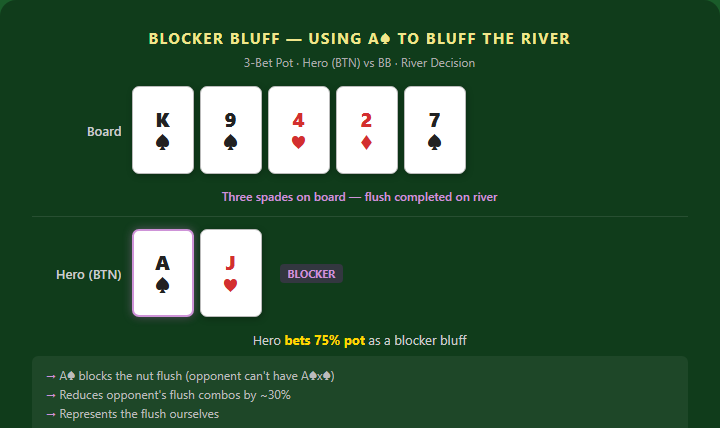
The moment blockers clicked for me was a river decision at NL200. I was on the button with A♠J♥ in a 3-bet pot. The board ran out K♠9♠4♥2♦7♠ — three spades by the river. I had nothing. No pair, no draw, complete air. But I looked at my A♠ and something clicked: my opponent literally cannot have the nut flush.
I bet 75% pot. He tanked and folded. When I reviewed the hand later in PT4, the math was stark: without the A♠, his range contained nearly 20% flush combinations. With it, those combos were all eliminated. My bluff’s success rate improved by at least 15 percentage points because of one card.
What Are Blockers?
The definition is straightforward: a blocker is a card you hold that reduces the combinations of hands your opponent can have that include that card.
Simple example:
- There are 4 aces in the deck. If you hold one ace, your opponent can only have 3 remaining aces.
- AA combinations drop from 6 (A♠A♥, A♠A♦, A♠A♣, A♥A♦, A♥A♣, A♦A♣) to 3.
- AK combinations drop from 16 to 12 (you’ve removed 4 combos containing your ace).
This sounds like pure math — and it is — but the practical impact is enormous. In my light 3-bet guide, I explained that A2s-A5s are the best light 3-bet hands partly because they block AA and AK, cutting your 4-bet risk nearly in half.
Three Key Applications of Blockers
Application 1: River Bluffs — Blocking Your Opponent’s Value Hands
This is the classic blocker play.
When the river completes a flush or straight and you happen to hold the key blocker card, your bluff becomes dramatically more effective. You’ve removed a chunk of your opponent’s strong hands from their range, making it more likely they’re holding something they can fold.
Common Blocker Bluff Scenarios
| Board | Your Hand | What You Block | Bluff Quality |
|---|---|---|---|
| K♠9♠4♥2♦7♠ (3 spades) | A♠J♥ | Nut flush (A♠x♠) | Excellent — opponent can’t have the nuts |
| A♥K♣Q♦J♠3♥ | T♣8♣ | Broadway straight (needs T) | Good — fewer straight combos for opponent |
| K♠K♦9♣5♥2♠ | K♥J♥ | Trip kings (needs K) | Good — opponent’s K combos: 2→1 |
The key point: you don’t need to block all of your opponent’s strong combos. Even significantly reducing the probability changes the math in your favor.
Application 2: Fold Decisions — Blocking Your Opponent’s Bluffs
Blockers work in reverse too: if you block your opponent’s likely bluff hands, they’re more likely to be value betting — and you should lean toward folding.
Example: River board A♥K♥8♣3♠5♥ — three hearts. Opponent bets full pot. You hold Q♥J♣ (no pair).
You might consider hero-calling. But look at your Q♥: it blocks your opponent’s Q♥x♥ flush bluffs. By holding that card, you’ve reduced the portion of their range that’s bluffing. They’re more likely to have a real flush or strong hand.
Contrast this with holding Q♣J♣ (no hearts). Now you don’t block any flush combos. Your opponent’s bluffing range is fully intact, and a call becomes more attractive.
This is the blocker principle for fold decisions: blocking opponent’s value hands → better for bluffing. Blocking opponent’s bluff hands → better for folding.
Application 3: Preflop Decisions — Blocking Premium Holdings
This is covered extensively in my light 3-bet guide, but the summary:
- Holding an ace: blocks AA (6→3 combos) and AK (16→12), dramatically reducing 4-bet risk
- Holding a king: blocks KK (6→3) and AK (16→12), weaker but still valuable
- No ace or king: opponent’s premium range is fully intact, light 3-bet risk is highest
The Math: How Much Do Blockers Actually Matter?
A lot of players think “a few fewer combos is no big deal.” Let me show you the actual numbers.
Flush Blockers
Assume the river completes a spade flush. Here’s how your hand affects your opponent’s flush combos:
Flush Blocker Effect
| Your Hand | Opponent’s Possible Flush Combos | Reduction |
|---|---|---|
| No spades | ~45 combos (baseline) | 0% |
| One spade (not A♠) | ~35 combos | ~22% |
| A♠ specifically | ~32 combos (and no nut flush possible) | ~29% |
| Two spades | ~26 combos | ~42% |
One A♠ eliminates nearly 30% of your opponent’s flush combos. On the river, where decisions are binary (call or fold, bet or check), that 30% swing is massive.
Pair Blockers
Board: A-K-8-3-2. Does your opponent have AA or AK?
- You hold no A or K: AA = 3 combos (one A on board), AK = 9 combos
- You hold one A: AA drops to 1 combo, AK drops to 6 — opponent’s top pair/set probability collapses
- You hold one K: AA stays at 3 but AK drops to 6
Blocker Categories: A Quick Reference
Not all blockers are created equal. Here’s a framework for thinking about blocker strength by category.
Tier 1: Nut Blockers (Strongest)
These block the absolute best hand your opponent can have. Examples:
- A♠ on a three-spade board — blocks nut flush
- Holding a T on a board of A-K-Q-J-x — blocks the broadway straight
- Holding a K on a K-K-x-x board — blocks quads and reduces trips
Nut blockers are the highest-quality bluff enablers because they eliminate the combos your opponent would never fold. If they can’t have the nuts, they’re more likely to have something foldable.
Tier 2: Range Blockers (Medium)
These don’t block the nuts specifically, but reduce significant portions of your opponent’s value range:
- Holding one ace on an A-high board — reduces opponent’s top pair combos
- Holding a queen on a Q-J-x board — reduces top pair and AQ combos
- Holding two cards of a suit when a flush draw is possible — reduces opponent’s flush draw combos
Range blockers are useful for semi-bluffs and turn decisions where you need to estimate how likely your opponent is to have connected with the board.
Tier 3: Marginal Blockers (Weakest)
These block some combos but the effect is too small to drive decisions alone:
- Blocking bottom pair on a three-tone flop
- Holding a 6 on a 9-7-5 board (blocks some gutshots but opponent has many other draws)
Don’t base bluffs on marginal blockers. They’re tiebreakers when you’re already on the fence, not decision drivers.
Common Blocker Mistakes
Mistake 1: “I Have a Blocker, So I Must Bluff”
Blockers make your bluff better, not automatic. You still need to evaluate: opponent’s full range, bet sizing, your table image, stack depth. A blocker bluff in a bad spot is still a losing play.
Mistake 2: “Blockers Only Matter on the River”
Blockers influence decisions on every street — preflop (light 3-bets), flop (C-bet decisions), turn, and river. They’re just most visible and quantifiable on the river because it’s the final betting round.
Mistake 3: “Blocking the Nuts Means I Should Always Bluff”
Blocking the nut hand reduces your opponent’s strongest combos, but they might have plenty of non-nut strong hands (second-nut flush, two pair, sets) that will still call. Blockers must be combined with full range analysis.
Mistake 4: Ignoring What You Don’t Block
Equally important to what you block is what you don’t block. If you block the flush but don’t block two pair, your opponent might call with two pair anyway. Evaluate the full picture, not just one dimension.
Three Real Hand Examples
Hand 1: Classic Blocker River Bluff
NL200 6-max. 3-bet pot, I’m on BTN, opponent in BB.
My hand: A♠J♥. Board: K♠9♠4♥2♦7♠.
River analysis: Three spades — flush completed. I have pure air. But I hold the A♠.
Blocker effect: A♠ blocks the nut flush (all A♠x♠ combos). The best flush my opponent can have is Q♠x♠ (K♠ is on the board). My A♠ also removes ~30% of all spade flush combos from their range.
Action: Opponent checks. I bet 75% pot. Opponent folds. The bluff worked largely because of the A♠ — it reduced their flush probability and made my bet look like a nut flush value bet.
Hand 2: Blockers Guide a Fold Decision
NL200 6-max. Single raised pot. I’m in the CO with J♥T♥.
Board: A♥K♥8♣3♠5♥. River completes the heart flush. BB opponent bets full pot.
Analysis: I hold J♥ and T♥ — two hearts. These cards block my opponent from using J♥x♥ or T♥x♥ as bluffs. With fewer bluffing combos in their range, their full-pot bet skews heavily toward value.
Decision: Fold. My hearts block too many of their potential bluffs. If I held J♣T♣ (no hearts) in the same spot, I’d be more inclined to call because their bluff range would be fully intact.
Hand 3: No Blockers = Don’t Bluff
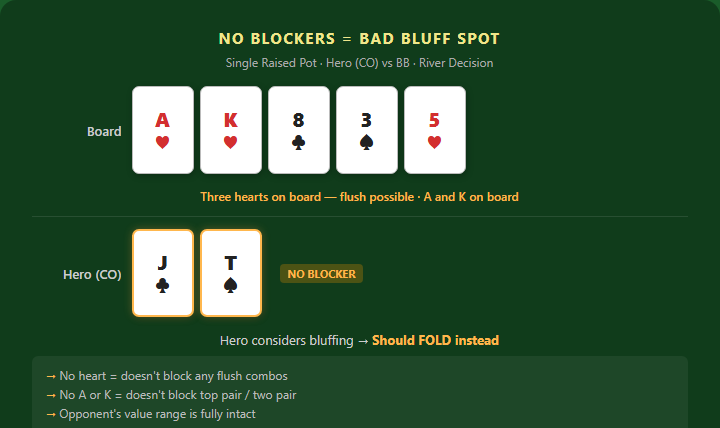
NL200 6-max. Board: A♥K♥8♣3♠5♥. I’m in the CO with J♣T♠. River completes the heart flush.
Analysis: I want to bluff representing the flush. But my hand — J♣T♠ — holds zero hearts.
- I don’t block any flush combos — opponent’s flush range is fully intact
- I don’t block A or K — their top pair / two pair range is also intact
- Opponent has plenty of value hands to call with
Correct play: Check-fold. Without blocker support, this bluff succeeds too infrequently to be profitable long-term.
Putting Blockers Into Practice: A Session Review Framework
Knowing about blockers intellectually and actually using them at the table are two different things. Here’s the framework I use to practice blocker thinking during my post-session reviews.
Step 1: Flag Every River Decision
Go through your hand history and tag every hand where you made a river bet/call/fold decision. These are the spots where blockers matter most.
Step 2: Write Down What You Block
For each tagged hand, write down: “My hand blocks [X]. My hand does NOT block [Y].” Force yourself to think about both sides. It’s easy to notice what you block and forget what you don’t — and the “don’t” side is equally important.
Step 3: Ask “Did Blockers Change My Decision?”
For each hand, ask whether the blocker information would have changed your decision if you’d considered it in real-time. If you bluffed the river without a blocker and got called, would you have folded if you’d run the blocker check? If you folded the river while holding key value-blockers, would you have bluffed?
Step 4: Count the Combos
This is the math step. For the most important hands, actually count the combinations your opponent can have with and without your blocker. The first few times you do this it’ll be slow and tedious. After a few sessions, it becomes second nature — you’ll start estimating combo reductions at the table without needing to count precisely.
I spent about two weeks doing this exercise after every session. It was boring. It was tedious. And it permanently changed how I think about river decisions. The ROI on that two weeks of work has been significant — I estimate it added 1-2BB/100 to my win rate just by improving my river bluff and call frequencies.
If you want to go deeper into the thinking framework that supports blocker analysis, my range thinking guide covers the foundations of how to assign and narrow opponent ranges — which is exactly what blockers help you do.
How Blockers Connect to Other Strategies
Blockers aren’t an isolated concept — they thread through multiple layers of poker strategy:
- Light 3-bets: A2s-A5s are premier light 3-bet hands largely because of the ace blocker
- Semi-bluffs: When you semi-bluff with a flush draw, your suited cards are themselves blockers — reducing the chance your opponent already has the made flush
- River play: River value bets and bluffs rely heavily on blocker analysis for optimal decision-making
- Range thinking: Blockers are a core range-narrowing tool — you use the information in your own hand to eliminate portions of your opponent’s range
Blocker Decision Checklist
At every critical decision point, ask yourself:
- What am I blocking? Identify which strong combos your hand removes from your opponent’s range.
- Am I blocking their value hands or their bluffs? Blocking value → good for bluffing. Blocking bluffs → good for folding.
- How significant is the blocking effect? Blocking an ace might remove 30% of combos (huge). Blocking a 9 might remove 5% (negligible).
- Do other factors support this decision? Don’t bluff just because you have a blocker. Combine it with range analysis, bet sizing reads, and opponent tendencies.
When Blockers Matter Most (and When They Don’t)
Blockers are most impactful in situations where ranges are narrow and decisions are close. That means:
High impact:
- River decisions in 3-bet pots — both players have narrow ranges, so removing a few combos shifts the math significantly
- Preflop 3-bet/4-bet decisions — blocking AA or AK cuts the top of their range, making light aggression viable
- Heads-up pots — with only one opponent, your blocker effects are concentrated on a single range
Low impact:
- Multiway pots — with three or more players, your single blocker card is diluted across multiple ranges. The chance that at least one opponent has the hand you’re blocking goes up sharply.
- Early streets with wide ranges — on the flop in a single-raised pot, both ranges are wide enough that removing a few combos barely moves the needle
- Against opponents who don’t fold — blocker math assumes your opponent is making somewhat rational fold/call decisions. Against a calling station, it doesn’t matter what you block — they’re calling anyway
The practical lesson: save your blocker analysis for spots where it actually changes the decision. If you’re facing a river bet in a 3-bet pot, think carefully about what you block. If you’re on the flop in a limped pot against three opponents, don’t waste mental energy on blocker math — there are bigger factors at play.
Blockers are the bridge from “playing by feel” to “playing by logic and probability.” Once you start incorporating them into every major decision, the post-flop game becomes clearer — your opponent’s range stops being a vague guess and starts being something you can systematically narrow using the information sitting right in front of you.