Light 3-Bet vs Value 3-Bet: When Each One Prints Money (and When It Doesn’t)
A value 3-bet uses a strong hand to build a bigger pot. A light 3-bet uses a weaker hand with specific properties to steal the pot preflop. Mix them up and you’ll 3-bet QQ “as a bluff” and A5s “for value” — burning money either way. This guide breaks down exactly which hands go where, by position and opponent type.
About six months into my NL200 grind, I ran a database filter that made me sick. My 3-bet winnings were almost entirely from AA, KK, and QQ. Every hand I’d been using for “light 3-bets” — A9o, KTo, Q9s — was a net loser. Not break-even. A loser. I was picking the wrong hands to bluff with and it was costing me real money.
The problem wasn’t that I was 3-betting too much. The problem was that I didn’t understand which hands should be value 3-bets, which should be light 3-bets, and which should just be folds. Once I sorted that out, my preflop win rate jumped by nearly 4BB/100 over the next 30k hands.
Value 3-Bet vs Light 3-Bet: The Core Difference
Let’s get the definitions right once and for all.
Value 3-Bet: Your hand is strong enough that you want to be called. You’re raising because you’re ahead of your opponent’s continuing range and you want the pot to grow. Classic value 3-bet hands: AA, KK, QQ, AKs, AKo, and position-dependent adds like JJ and AQs.
Light 3-Bet: Your hand isn’t strong enough to profit from being called, but it has specific properties that make it a good bluffing candidate. You’re raising because you want your opponent to fold. If they call, you still have some playability to fall back on. Classic light 3-bet hands: A5s-A2s, 87s, 76s, 65s, sometimes KQo.
Value 3-Bet vs Light 3-Bet
| Dimension | Value 3-Bet | Light 3-Bet |
|---|---|---|
| Purpose | Build the pot while ahead | Win the pot through folds |
| When called | Usually ahead, in good shape | Usually behind, but playable |
| Profit source | Pot equity | Fold equity |
| Typical hands | AA, KK, QQ, AKs, JJ | A5s-A2s, 76s, 87s, KQo |
| Frequency | 40-60% of 3-bet range | 40-60% of 3-bet range |
| Facing 4-bet | Call or shove | Almost always fold |
The fundamental math is different. Value 3-bets profit because your hand has more equity than your opponent’s calling range — bigger pot means bigger winnings. Light 3-bets profit because (fold frequency × pot size) minus (call frequency × your losses when called) nets out positive.
Why You Can’t Just Value 3-Bet
A lot of players ask: “Can’t I just 3-bet with QQ+ and AK and call it a day? Those are my best hands anyway.”
In the short run, sure. In the long run, you’re leaving serious money on the table. Here’s why.
1. Your Range Becomes Transparent
If you only 3-bet with premium hands, any thinking opponent will notice within a session or two. When you 3-bet, they fold everything except traps. Your aces never get action. Your kings never build big pots. You’ve turned your strongest hands into a “please fold” sign.
2. You’re Missing Free Money
At NL200, CO and BTN opening ranges are typically 25-35%. Against a 3-bet, these ranges fold 55-65% of the time. If you’re not picking up those dead pots with light 3-bets, you’re leaving 3-5BB/100 on the table. Over a year, that’s thousands of dollars.
3. Balance Makes Your Value Hands More Profitable
When your 3-bet range includes both AA and A5s, opponents can’t narrow your holdings. They’re forced to continue with a wider range against your 3-bets — which means your premium hands get paid off more often.
After I added light 3-bets to my game, my overall 3-bet fold rate dropped from 65% to about 52%. But my average pot size when I had AA or KK in a 3-bet pot increased by 40%. Opponents couldn’t be sure I always had the goods anymore.
Four Principles for Choosing Light 3-Bet Hands
Not every hand that’s “not good enough for value” makes a good light 3-bet. Pick the wrong hands and you’ll lose more than if you’d never 3-bet at all. These four principles took me a long time to figure out.
Principle 1: Blocker Effect
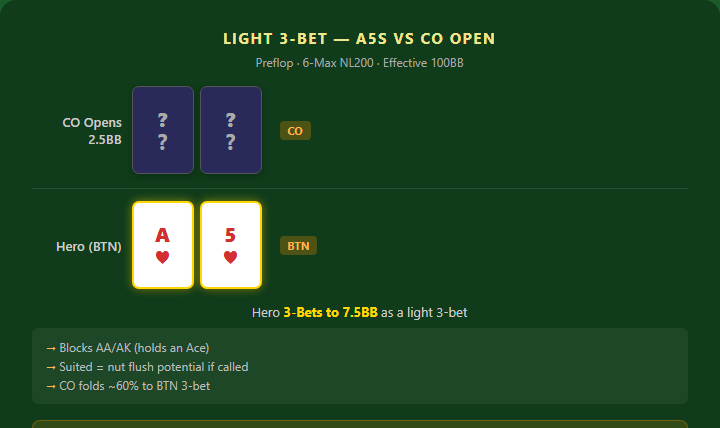
Holding an Ace reduces the number of AA combinations your opponent can have from 6 to 3, and AK from 16 to 8. That cuts the probability of getting 4-bet roughly in half.
This is why A2s through A5s are the best light 3-bet hands in the game. They block the premium holdings that would punish you, and being suited means you can occasionally flop the nut flush.
Principle 2: Playability
When you do get called, you need to be able to continue on some flop textures. Suited hands outperform offsuit hands because they can pick up flush draws. Connectors outperform gappers because they can make straights.
That’s why KJo is a terrible light 3-bet but KJs is debatable. One suit changes your post-flop life dramatically.
Principle 3: Fold Comfort
When you get 4-bet, you need to be able to fold without a second thought. If you’re 3-betting KQs and facing a 4-bet, you’ll agonize — the hand feels too good to fold but isn’t strong enough to continue. These “in-between” hands are the worst possible light 3-bet candidates.
KQs, AJo, and KJs shouldn’t be light 3-bet hands. They play better as flat calls in position. Hands like A5s and A4s — which you can toss without any emotional attachment — are the correct choices.
Principle 4: Positional Dynamics
Your light 3-bet range shifts dramatically based on who opened and from where:
- BTN vs CO/HJ: Widest light 3-bet range. Their opening range is wide, fold-to-3-bet is high, and you have position.
- BB vs BTN/CO: Moderate light 3-bet range. You lack position but they open wide.
- Any position vs UTG: Minimal or no light 3-bets. UTG range is too tight and fold-to-3-bet too low for light 3-bets to be profitable.
Position-by-Position 3-Bet Ranges
Here are the 3-bet ranges I actually use at NL200, broken down by positional matchup. These are starting points — adjust based on opponent tendencies (covered in the next section).
BTN vs CO Open (Most Common 3-Bet Spot)
BTN vs CO 3-Bet Range
Value: AA, KK, QQ, JJ, AKs, AKo, AQs
Light: A5s-A2s, 87s, 76s, 65s, KQo (mixed frequency)
Total 3-bet frequency: ~10-12%
Value:bluff ratio: ~55:45
Why is the BTN’s light 3-bet range the widest? Three reasons: you have position post-flop, CO’s opening range is wide (25-30%), and CO’s fold-to-3-bet from the button is highest (typically 55-65%).
BB vs BTN Open
BB vs BTN 3-Bet Range
Value: AA, KK, QQ, JJ, TT, AKs, AKo, AQs, AQo
Light: A5s-A2s, K9s-K7s, Q9s, J9s, T9s
Total 3-bet frequency: ~9-11%
Value:bluff ratio: ~50:50
From the BB you lack position, so your value range needs to be wider (adding TT and AQo). Your light 3-bet hands should prioritize playability — suited connectors and one-gappers over pure blocker hands.
SB vs CO/BTN Open
SB vs CO/BTN 3-Bet Range
Value: AA, KK, QQ, JJ, TT, AKs, AKo, AQs
Light: A5s-A3s, 76s, 65s, 54s
Total 3-bet frequency: ~8-10%
Note: SB is tricky because even if you win the 3-bet pot preflop, you’re still out of position post-flop if BB calls.
Any Position vs UTG Open
vs UTG 3-Bet Range
Value: AA, KK, QQ, AKs (only the top of the range)
Light: Almost never. UTG range is too tight (10-15%), fold-to-3-bet is too low (35-45%). The math doesn’t work for light 3-bets.
Total 3-bet frequency: ~4-5%
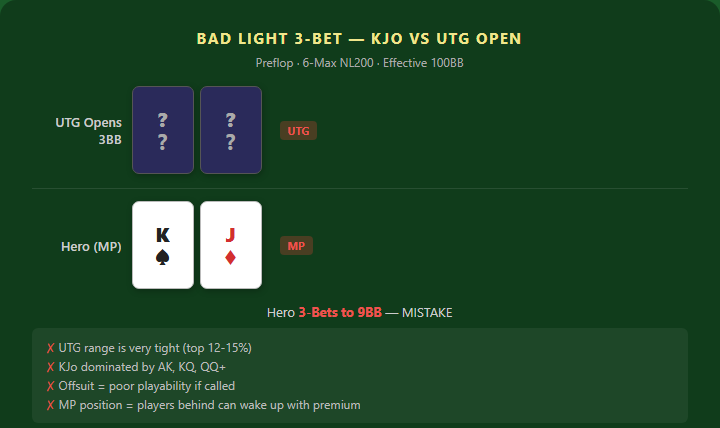
I once made a classic mistake: 3-betting KJo from MP against a UTG open. It felt “aggressive” and “pro.” In reality, UTG’s calling range (JJ+, AQs+) dominates KJo completely. I lost 80BB in that hand. Never again.
Adjusting by Opponent Type
The ranges above are baseline against a standard TAG (tight-aggressive) player. Against different player types, you need to adjust. For more on identifying and exploiting player types, check out my guide to adjusting against different player types.
Against Nits: Expand Light 3-Bets
Nits open tight but fold to 3-bets at insane rates (70%+). You can widen your light 3-bet range to include K5s, Q8s, even J8s. Their fold frequency makes nearly any 3-bet profitable.
The catch: If a nit calls your 3-bet or 4-bets, their range is incredibly narrow and strong. Your light 3-bet hands are drawing nearly dead post-flop. Give up immediately.
Against Fish: Cut Light 3-Bets, Widen Value
Fish call too much and fold too little. Your light 3-bets lose their main profit source (fold equity). Instead, dramatically reduce light 3-bets and expand your value range to include JJ, TT, AQo, AJs. These hands crush a fish’s wide calling range.
Against LAGs: Go Polarized
LAGs open wide and don’t fold easily — they might flat or 4-bet bluff. The best approach is a polarized 3-bet range:
- Value end: AA-JJ, AKs, AKo, AQs (strong enough to handle a 4-bet)
- Bluff end: A5s-A2s, 76s (blockers + playability)
- Middle hands (KQs, AJo, TT): Flat call instead of 3-bet — avoid playing a medium-strength hand in a 3-bet pot against someone who won’t fold
3-Bet Sizing: Should Light and Value Be Different?
The answer is absolutely not.
If your value 3-bets are 11BB and your light 3-bets are 8BB, any decent opponent will figure out the pattern within a session. Big raise = big hand, small raise = bluff. Your entire 3-bet strategy collapses.
Standard 3-bet sizing reference:
3-Bet Sizing Guide
| Scenario | In Position | Out of Position |
|---|---|---|
| Vs 2.5BB open | 7-8BB | 9-10BB |
| Vs 3BB open | 8-9BB | 10-11BB |
| Vs 3BB open + caller | 11-13BB | 13-15BB |
Key principle: OOP sizing is 20-25% larger than IP sizing, because your positional disadvantage post-flop needs to be compensated with a bigger pot preflop.
I discussed blind-position 3-bet sizing in detail in my steal and resteal strategy article. The bottom line: whether you’re holding aces or A5s, your 3-bet size from the same position should be identical.
Facing a 4-Bet: The Defining Moment
This is where the distinction between value and light 3-bets matters most.
Value 3-Bets Facing a 4-Bet
Your response depends on your specific hand and opponent tendencies:
- AA, KK: 5-bet shove virtually always. Against anyone, from any position.
- QQ: Shove against most opponents. Only fold against a known extreme nit’s UTG 4-bet.
- JJ, AKs: Depends on opponent’s 4-bet frequency. If they 4-bet wider than 8%, shove. If they only 4-bet AA-QQ, fold.
- AKo, AQs: Usually call and see a flop (rather than 5-bet shoving), unless stacks are short (<60BB).
Light 3-Bets Facing a 4-Bet
Simple: fold.
This is exactly why hand selection for light 3-bets matters. A5s facing a 4-bet? Fold, zero regret. 76s facing a 4-bet? Fold, don’t even think about it.
If you find yourself frequently agonizing over whether to fold when 4-bet, you’re choosing the wrong light 3-bet hands. You’re probably 3-betting KQs or AJo — hands that feel “too good to fold” but aren’t strong enough to continue. Go back and re-read the fold comfort principle above.
Three Real Hand Examples
Hand 1: Textbook Value 3-Bet
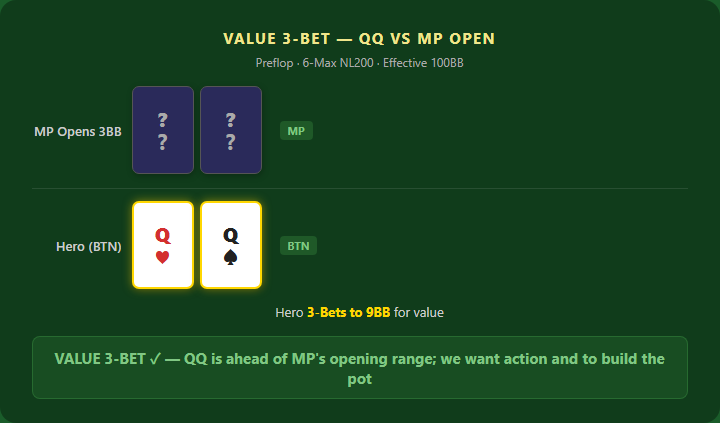
NL200 6-max. CO reg (28/22/8) opens to 3BB. I’m on the BTN with Q♥Q♠.
Analysis: QQ crushes CO’s opening range (~25%). Even against his calling range (JJ-77, AQs-ATs, KQs, AJo), we’re comfortably ahead. This is a clear value 3-bet — I want action.
Action: 3-bet to 9BB. He calls. Flop T♥7♣2♦, he checks, I bet 5BB into an 18BB pot. He folds. Although he folded this time, the long-term EV of this spot is solidly positive.
Hand 2: Well-Executed Light 3-Bet
NL200 6-max. HJ reg (25/20/6) opens to 2.5BB. I’m in the CO with A♥4♥.
Analysis: A4s isn’t a value hand — it has less than 50% equity against HJ’s opening range. But it has three properties that make it perfect for a light 3-bet: it blocks AA/AK (reducing 4-bet probability), it’s suited (nut flush potential when called), and it folds to a 4-bet with zero psychological cost.
Action: 3-bet to 7.5BB. Blinds fold, HJ tanks for 5 seconds and folds. I win 4.5BB clean. This spot comes up 6-8 times per 100 hands. The cumulative profit is substantial.
Hand 3: Bad Light 3-Bet (What Not to Do)
NL200 6-max. UTG nit (16/12/4) opens to 3BB. I’m in MP with K♠J♦.
Why this 3-bet is wrong:
- UTG nit’s range is only about 12% — JJ+, AQs+, AKo. KJo gets dominated by almost everything in this range.
- His fold-to-3-bet is only 35-40% — far below the breakeven threshold.
- KJo is offsuit — terrible playability if called.
- Facing a 4-bet, you’ll agonize. It “looks decent” but it’s actually dead against his 4-bet range.
Correct play: Fold. KJo barely has enough equity to flat against a UTG nit’s open, let alone 3-bet.
How Light 3-Bets Connect to Semi-Bluffs
If you’ve read my semi-bluff strategy guide, you might notice that light 3-bets and semi-bluffs share a core principle: fold equity plus pot equity equals a profitable aggressive play.
The difference is timing. Semi-bluffs happen post-flop (you have outs but lack made-hand strength). Light 3-bets happen preflop (your hand isn’t strong enough for value but has useful properties). Both rely on a “backup plan” — light 3-bets fall back on post-flop playability, semi-bluffs fall back on hitting their outs.
For a deeper dive into range-based thinking and how to continue in 3-bet pots, check out my range thinking guide. And for the post-flop continuation betting strategy that pairs perfectly with preflop 3-bets, read my C-Bet strategy guide.
Your 3-Bet Checklist
Before every 3-bet, run through this quickly:
- Is this a value 3-bet or a light 3-bet? You must know the answer before you raise. If you’re unsure, you’ve probably picked the wrong hand.
- What position did villain open from? A BTN open and a UTG open require completely different 3-bet strategies.
- What’s their fold-to-3-bet? Light 3-bets only profit when fold frequency is high enough. Against fish, cut them down.
- Does your hand have blockers? A5s blocking AA/AK dramatically reduces your chance of running into the top of their range.
- Do you have a plan when called? A 3-bet isn’t raise-and-pray. You need a flop strategy.
- What do you do facing a 4-bet? Value hands consider shoving. Light 3-bets fold immediately. If you’re torn, you picked the wrong hand.
Common Misconceptions About 3-Betting
Before wrapping up, let me address a few myths I see repeated in poker forums and low-stakes Discord channels.
“You should 3-bet or fold from the small blind — never flat.” This is a simplification that works reasonably well at higher stakes but falls apart against recreational players. If the button is a fish who never folds to 3-bets, flatting with suited connectors and small pairs from the SB is perfectly fine. Don’t let rigid strategy rules override common sense.
“Light 3-betting doesn’t work at low stakes because nobody folds.” Partially true. At NL25 and below, many opponents call 3-bets too wide. But the solution isn’t to eliminate light 3-bets entirely — it’s to shift toward exploitative play. Reduce light 3-bets against calling stations, but keep them against the regulars who fold too much. Even at micro stakes, there are players folding 60%+ to 3-bets. Find them and exploit them.
“3-betting is all about hand strength.” If this were true, you’d never 3-bet A5s. The reality is that 3-betting is about range construction. You need value hands for when you’re called and bluff hands that make your value hands harder to read. A5s isn’t a strong hand — but it’s a strong 3-bet candidate because of its properties (blocker, suitedness, fold comfort). These are different concepts.
The 3-bet is one of the most profitable preflop plays available — but only when you understand the split between value and bluff, choose the right hands, and deploy them against the right opponents in the right positions. Master this distinction and your preflop game takes a meaningful step forward.