Poker Straight Rules Explained: Ace-High, Ace-Low, Tiebreakers, and Common Mistakes
A straight is five cards in sequential order, regardless of suit. The ace can be used as the highest card (A-K-Q-J-10) or the lowest card (A-2-3-4-5), but NOT as a “wraparound” (Q-K-A-2-3 is NOT a straight). When two players both have a straight, the one with the highest top card wins. These rules trip up more beginners than almost anything else in poker.
The hand that taught me straight rules the hard way happened at a home game. The board was 3♥4♠5♦K♥Q♠. I had A♦2♣ and announced “straight!” — ace through five. My buddy across the table had 6♥7♣ and also said “straight!” — three through seven. I genuinely didn’t know who won. We stared at each other for ten seconds before someone Googled it.
His straight won. A 7-high straight beats a 5-high straight (the “wheel”). The ace acting as a low card makes the wheel the lowest possible straight, not a high one. That lesson cost me $40 and a fair amount of dignity. Here’s everything I’ve learned about straight rules since then.
What is a straight in poker?
A straight is five cards in consecutive rank order. The suits don’t matter — you can have five different suits and it’s still a straight. If all five cards happen to be the same suit, that’s a straight flush, which is a much stronger hand.
Examples of a straight:
- A♠ K♥ Q♦ J♣ 10♥ — Ace-high straight (the “Broadway”)
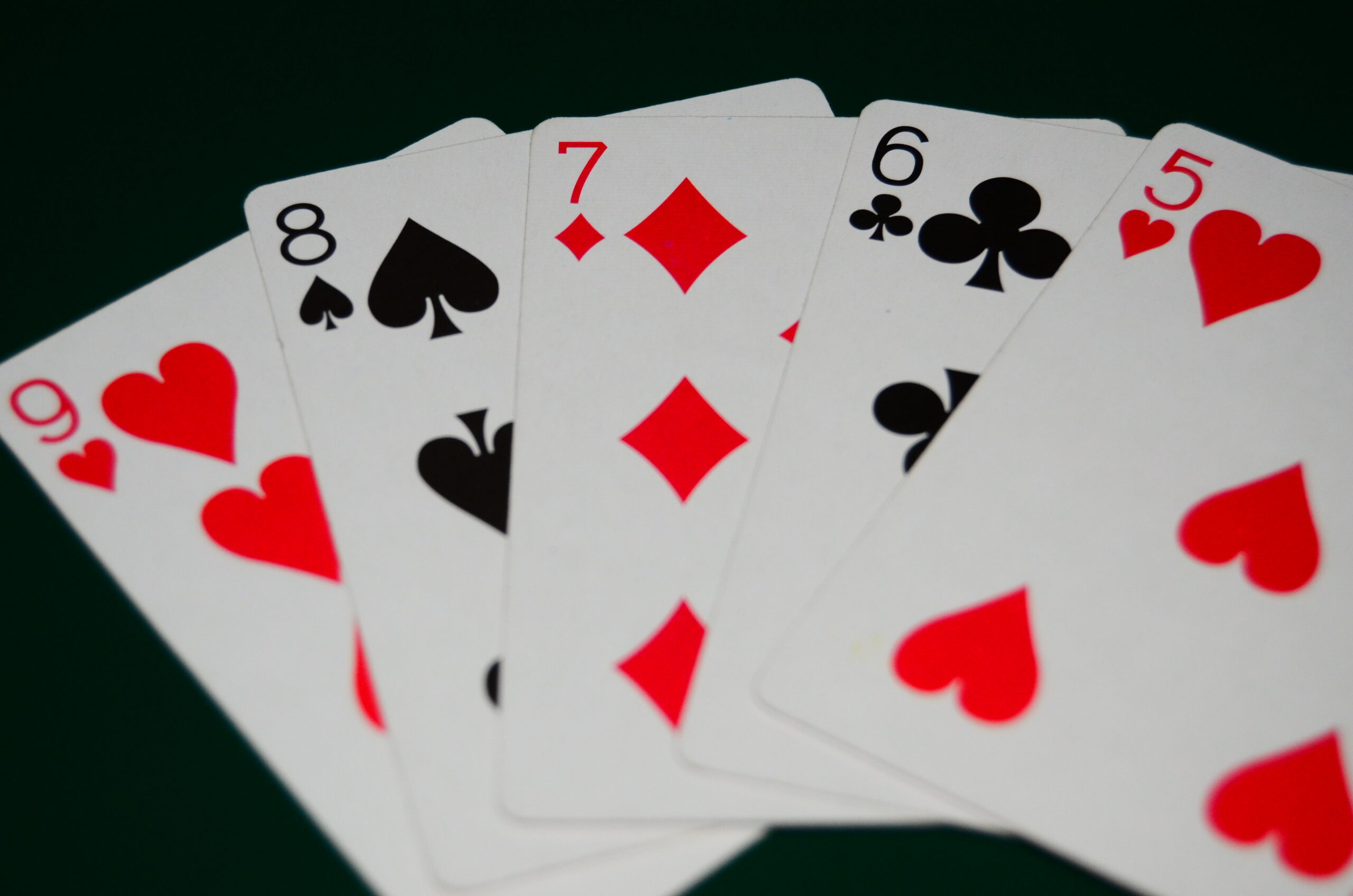
- 9♥ 8♠ 7♦ 6♣ 5♥ — Nine-high straight
- 5♦ 4♣ 3♥ 2♠ A♥ — Five-high straight (the “Wheel”)
NOT a straight:
- Q♥ K♠ A♦ 2♣ 3♥ — “Wraparound” is not valid in standard poker
- A♥ A♠ K♦ Q♣ J♥ — Pairs don’t count as sequential
Where does a straight rank?
A straight is a solid mid-range hand:
| Rank | Hand | Beats Straight? |
|---|---|---|
| 1 | Royal Flush | Yes |
| 2 | Straight Flush | Yes |
| 3 | Four of a Kind | Yes |
| 4 | Full House | Yes |
| 5 | Flush | Yes |
| 6 | Straight | — |
| 7 | Three of a Kind | No |
| 8 | Two Pair | No |
| 9 | One Pair | No |
| 10 | High Card | No |
Key thing to remember: a straight loses to a flush. This catches a lot of new players off guard. If the board has three cards of the same suit and your opponent has two more, your straight is no good. For a full comparison of every hand, check our hand rankings reference.
The ace rule: high, low, but never wraparound
The ace is the most confusing card when it comes to straights. Here’s exactly how it works:
Ace as the highest card (Broadway straight)
A-K-Q-J-10 is the highest possible straight, called a “Broadway.” The ace sits at the top. This is the nut straight — no straight can beat it.
Ace as the lowest card (the Wheel)
A-2-3-4-5 is the lowest possible straight, called the “Wheel.” Here, the ace functions as a 1. This is a valid straight, but it’s the weakest one — any other straight beats it.
Wraparound: NOT valid
Q-K-A-2-3 is NOT a straight. The ace cannot be both high and low at the same time, and it cannot “wrap around” from king to deuce. This is the single most common straight mistake I see beginners make.
Valid vs. invalid:
- A-K-Q-J-10 — Valid (Broadway)
- A-2-3-4-5 — Valid (Wheel)
- K-A-2-3-4 — NOT valid
- Q-K-A-2-3 — NOT valid
- J-Q-K-A-2 — NOT valid
I once argued with a home game player for fifteen minutes about whether K-A-2-3-4 was a straight. He was absolutely convinced it was. We eventually looked it up, and he was shocked. Years of house rules had given him wrong assumptions. In standard poker, the ace wraps one way or the other — never both.
Straight tiebreakers: two players both have a straight
When two or more players both have a straight, the rules are straightforward (pun intended):
The straight with the highest top card wins
Example:
- Player A: 10-9-8-7-6 (ten-high straight)
- Player B: 9-8-7-6-5 (nine-high straight)
Player A wins. Their straight goes one rank higher.
If both straights have the same top card, it’s a split pot
Unlike a flush where you compare card by card, a straight is defined entirely by its top card. If both players have the same top card, they necessarily have the exact same straight — and the pot is split.
Example:
- Board: 6♥ 7♠ 8♦ 9♣ K♥
- Player A: 10♠ 2♥ (has 10-high straight: 10-9-8-7-6)
- Player B: 10♦ 3♣ (has 10-high straight: 10-9-8-7-6)
Split pot. Both have the exact same straight. The 2 and 3 are irrelevant — only the best five cards matter.
This happens more often than you’d think, especially when four cards to a straight are on the board. For a deeper look at all tiebreaker situations, see our same-hand tiebreaker guide.
Common straight scenarios that confuse people
The board makes a straight — who wins?
If the board is 5-6-7-8-9, every player has at least a nine-high straight. A player holding a 10 has a ten-high straight and wins. A player holding a J-10 has a jack-high straight and beats the ten-high. If nobody has a card that extends the straight, it’s a split pot using the board.
Two straights are possible on the same board
Consider a board of 4-5-6-8-9. Player A has a 7 (making 4-5-6-7-8 or 5-6-7-8-9). Player B has a 3-7 (making 3-4-5-6-7). Which straight each player has depends on which five cards make the highest straight. Player A would play 5-6-7-8-9 (nine-high straight), and Player B would play 5-6-7-8-9 too if they use the 7 — but they’d also be playing 3-4-5-6-7 (seven-high straight) if that was their best option. Always use the highest possible straight.
Straight vs. straight with community cards
Board: J♥ 10♠ 9♦ 3♣ 2♥. Player A has Q-8 (Q-J-10-9-8, queen-high straight). Player B has K-Q (K-Q-J-10-9, king-high straight). Player B wins. Even though they share three board cards, Player B’s straight goes one higher.
5 straight mistakes every beginner makes
Mistake 1: The wraparound straight
I already covered this above, but it bears repeating because it’s so common. Q-K-A-2-3 is never a straight. If you find yourself counting “…Queen, King, Ace, Two, Three” and it feels weird — that’s because it doesn’t work.
Mistake 2: Thinking the wheel beats other straights
A-2-3-4-5 is the lowest straight, not a special high hand. A lot of beginners think “ace means it’s high!” Nope. When the ace is used as a low card, the straight tops out at 5. Any straight from 6-high upward beats it.
Mistake 3: Forgetting that a flush beats a straight
You flop a beautiful straight, bet big, and your opponent calls with a flush draw. The river completes the flush, and suddenly your straight is worthless. Always be aware of flush possibilities on the board — three or more cards of the same suit should make you cautious with just a straight.
Mistake 4: Not seeing the straight on the board
Sometimes the board makes a straight and you don’t even notice. Board: 3-4-5-6-7. Your opponent with any 8 has an eight-high straight. Your opponent with any 2 has a seven-high straight. If you don’t have a card that improves on the board’s straight, you’re playing the board. Missing a straight on the board is embarrassing, but it happens to everyone.
Mistake 5: Overplaying the low end of a straight
Board: 8-9-10. You have 6-7 (making a 6-7-8-9-10 straight). This feels great until you realize anyone with J-Q, J-7, or even just a J has a higher straight. Playing the “idiot end” (bottom end) of a straight is one of the fastest ways to lose a big pot. The board practically advertises that someone could have a higher straight.
Quick straight rules cheat sheet
- What is it? Five consecutive cards, any suit
- Ranking: Beats three of a kind, two pair, one pair, high card. Loses to flush, full house, four of a kind, straight flush, royal flush.
- Ace rule: Can be high (A-K-Q-J-10) or low (A-2-3-4-5), but NEVER wraparound.
- Tiebreaker: Highest top card wins. Same top card = identical straight = split pot.
- Highest straight: A-K-Q-J-10 (Broadway)
- Lowest straight: A-2-3-4-5 (Wheel)
- Straight draw odds: Open-ended ~31.5% flop-to-river, gutshot ~16.5% flop-to-river
FAQ: Straight rules questions I hear the most
Does a straight have to be all one suit?
No. A straight can be any combination of suits. If it IS all one suit, that’s a straight flush — which is a much stronger hand. A regular straight just needs five consecutive ranks in any suits.
Can you make a straight with only one hole card?
Yes. If the board has four cards to a straight and you have the fifth, that counts. For example, board is 5-6-7-8 and you have a 9 — you have a nine-high straight. This is common and perfectly valid.
What’s the difference between an open-ended straight draw and a gutshot?
An open-ended straight draw (OESD) needs one of two ranks to complete (8 outs). Example: you have 6-7 and the board has 8-9 — any 5 or any 10 makes your straight. A gutshot needs one specific rank in the middle (4 outs). Example: you have 6-8 and the board has 9-10 — only a 7 works. For more on playing draws, see our draw strategy guide.
In Short Deck poker, does the straight ranking change?
Yes. In Short Deck (Six Plus Hold’em), a flush beats a full house, and A-6-7-8-9 is the lowest straight (replacing A-2-3-4-5 since 2s through 5s are removed). The straight hierarchy changes because the deck is different. Check our Short Deck rules guide for the full breakdown.