Is QQPK a Scam? A Checked Review of Withdrawals and Games
QQPK is not a shell operation: roughly five years running, a peak of 600+ tables online at once, licensed by the Government of the Autonomous Island of Anjouan, and four verifiable professional players listed publicly as brand ambassadors. Withdrawals are uncapped and normally clear in 5–60 minutes; only accounts flagged for suspected collusion face extended review (up to about 24 hours). In short: play normally and your money moves normally.
This site has a commercial relationship with QQPK. This review is written from operator-provided operational details and publicly accessible pages, and contains no signup, download or deposit links. Known shortcomings are included, and every claim below is checkable using the method described later in the article.
People searching “is QQPK a scam” usually want three things confirmed: will the site disappear with my money, can I actually withdraw, and are the games real. So this piece skips the promotions and the how-to-play and checks those three.
One thing up front: every online poker site carries risk. What can actually be checked is whether the operational footprint is real, whether the money process is explained clearly, and whether there’s a mechanism when something goes wrong. I’ll say where each claim comes from, and I’ll include the things it does badly — a review with nothing negative in it is a review with a problem.
Is the platform genuinely operating?
The most direct test of whether a poker site is a shell isn’t what it advertises — it’s real game density plus outside partnerships you can cross-check independently.
QQPK has been running about five years, with players concentrated across Europe/US, Chinese-speaking markets and Southeast Asia. The operator reports a peak of 600+ tables running simultaneously — mid-to-upper tier among Chinese-facing poker sites, not the kind of empty lobby where you open it and find three tables.
More telling is actual tournament turnout. Here’s the live tournament lobby — note the player counts on each event:
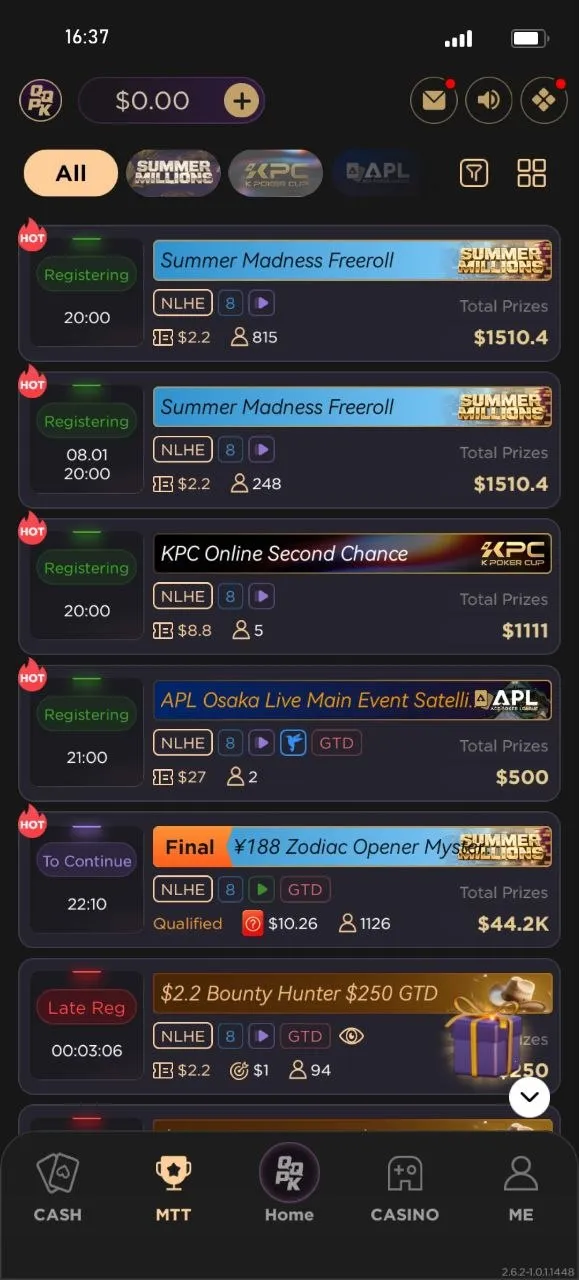
815 entries in one freeroll, 248 in another, and 1,126 in the final stage of the Zodiac Opener Mystery Bounty. A freeroll pulling eight hundred players says the user base is real — empty freerolls are exactly where shell platforms give themselves away.
The part you can verify yourself
The site publicly lists four brand ambassadors, and this is the one claim I’d encourage you to check independently, because it’s verifiable without taking anyone’s word for it:

- Punnat Punsri (Thailand)
- Danny Tang (Hong Kong)
- Webster Lim (Malaysia)
- Nishant Sharma (India)
All four are professionals with public tournament records — not stock photos with invented names. Nishant Sharma won a WSOP bracelet in 2026, an event this site covered independently, and you can cross-check any of them against a public tournament database in about a minute.
Professionals attaching their names publicly means the platform cleared at least their level of due diligence. That isn’t a guarantee, but it carries considerably more weight than a site asserting its own legitimacy.
It’s worth being precise about why this signal matters, because it’s easy to overrate. An ambassador deal is a commercial arrangement, not an audit — nobody is auditing the platform’s books because they wear its logo. What it does tell you is narrower but still useful: a working professional’s reputation is their main asset, and being publicly attached to an operation that stops paying players would damage it in a community small enough that everyone finds out. That’s a real incentive, and it’s why the signal is worth more from active tournament players than from an anonymous “team”.
The platform also partners with live circuits including the Asia Poker League (APL) and KPC (K Poker Cup), and runs satellites into live main events in Osaka, Jeju and Malaysia. Live events cost real money to stage — it’s not a cost structure a pure scam operation takes on.
Can you actually withdraw, and how long does it take?
This is the core of the scam question. Everything else is secondary.
| Item | Actual |
|---|---|
| Normal clearing time | 5–60 minutes |
| When flagged by risk control | Up to about 24 hours |
| Withdrawal cap | None (users have withdrawn 20,000 USDT in one go) |
| Methods | USDT, bank card, third-party payment |
The process matters here: withdrawals are not automatic — every request passes a manual review. A normal account submits, review clears it, funds move, typically inside an hour.
The operator states that even when review runs past 24 hours, requests are approved as long as there’s no genuine problem with the account. I can’t verify that on your behalf, but it is at least a specific commitment rather than a vague one — sites that really do have withdrawal problems are precisely the ones that won’t give you any timeframe at all.
So why do people still say withdrawals are slow?
This is QQPK’s most frequent complaint, and it deserves its own section because it’s simultaneously the weakness and the reason to trust it.
The delay comes from risk review. The platform checks whether several accounts that know each other are working together at the same table or in the same tournament — collusion, in other words. Flagged accounts take longer to review; serious cases can end in a ban, though the operator says an explanation is provided.
How you read that depends on which side of it you’re on:
- As a regular player: this is good news. The thing that actually costs you money at the table isn’t bad luck — it’s two players on a voice call sharing hole cards. Without this review, colluders would be the fastest withdrawers on the site.
- As someone waiting on your money: genuinely annoying. An hour becomes a day, and you often won’t know why while it’s happening.
My read: this is the cost of a mechanism, not a reluctance to pay out. The distinction matters — the former has a stated ceiling and an appeals path; the latter is indefinite delay followed by silence. If what you’re experiencing is the latter, that’s the real warning sign.
For a platform-agnostic checklist on judging online poker safety, see our guide to playing online poker for real money safely.
Are the games fair? Could you run into cheating?
The platform runs anti-collusion systems — the withdrawal review described above is part of that same apparatus, working backwards from payouts to flag table behaviour.
But let me be straight about this: no online poker site can guarantee zero cheating. That isn’t specific to QQPK — it’s true everywhere. RTA (real-time assistance software), multi-accounting and table collusion are industry-wide problems; sites differ only in how much they invest in detection and how decisively they act.
What can be confirmed is that QQPK does invest in it, to the point that it visibly slows down withdrawals. That at least indicates the detection isn’t decorative. How effective it is, nobody — including the operator — can give you a verifiable number for.
There’s a structural point worth understanding here, because it explains a pattern you’ll see across the whole industry. Detection and payout speed pull against each other: the more thoroughly a site screens for collusion before releasing funds, the slower some withdrawals get. A platform that pays out instantly in every case is either screening after the fact or not screening much at all. So “fast withdrawals” and “well-policed games” are, to a degree, competing promises — and a site advertising both without qualification is worth a second look rather than a first deposit.
If this matters to you, the practical approach is the same one I’d give for any new site: play low stakes first, watch for unusual patterns at the table, then decide whether to scale up. For more on how the online game differs from live, see online vs live poker.
What are the real problems?
This is the section I’d actually read. All of the below are shortcomings the operator acknowledges directly:
Slow withdrawal review — the number one complaint
Cause explained above. Objectively, if you’re used to instant payouts, the experience here is noticeably worse. Communication during a flagged review is also not timely enough — you’re often left waiting without knowing why.
Promotional rewards expiring unclaimed
Promo packages have expiry dates and are forfeited once they lapse, and the expiry reminders aren’t prominent enough — plenty of players only discover it when they go to claim. Not severe, but bad for perception, particularly for new users whose first experience is “the thing I was promised is gone.”
Occasional lag at peak times
Lag shows up when concurrency is high. If it affects your betting — a button that won’t respond when you need to act — the operator says you can contact support, and compensation is issued after review. Having a compensation channel is good, but you have to initiate the claim; nothing is credited automatically. Worth knowing if you play higher stakes or important tournaments.
On regulation: the platform is licensed and regulated by the Government of the Autonomous Island of Anjouan, Union of Comoros, under licence No. ALSI-202603009-FI1, authorising games of chance and betting operations within that licence’s scope; the operating entity is registered in the British Virgin Islands. The licence number is the part that matters — a number can be checked against the issuing authority, whereas “fully licensed” on its own cannot. Make that your habit anywhere you deposit: ask for the number, then verify it yourself.
How do you check a poker site yourself?
Don’t take this or any other review at face value. The checks below take about fifteen minutes and work on any platform, including this one — run them yourself before depositing anywhere.
Do all of this before you deposit, not after. Every one of these checks is available without funding an account.
- Open the freerolls at peak hour. This is the fastest liquidity test there is. Free tournaments cost players nothing to enter, so if a site can’t fill them, it has no user base. Hundreds of entries means real people; a dozen means an empty room.
- Cross-check every named person. Ambassadors, sponsored pros, “team members” — search their names in a public tournament database. Real professionals have years of recorded results across multiple events and venues. Invented names return nothing, and stock photos turn up on reverse image search.
- Look for live event ties, then verify them independently. Satellites into a named live festival are checkable — search the festival itself and see whether the partnership is acknowledged from the other side. Staging live events costs real money, which is why pure scams rarely bother.
- Ask support two specific questions before depositing: what is the maximum withdrawal processing time, and what triggers a manual review? A legitimate operation gives you numbers and conditions. Evasive or purely reassuring answers here are the single strongest warning sign you’ll get.
- Test the withdrawal path with a small amount first. Deposit modestly, play a little, then withdraw a small sum before you scale up. What matters isn’t the speed of that first payout — it’s whether the process behaves the way support described it.
- Search the platform name alongside complaint terms in the languages of its main markets, not just English. Problems usually surface first in the community where most of the players actually are.
Applied to QQPK, those checks come back consistent: the freerolls fill, the four ambassadors verify, the live circuit partnerships exist, the licence is stated with a checkable number, and the withdrawal terms come with specific figures rather than reassurance.
Who is it a good fit for — and who isn’t?
Cash game stakes first (denominated in USDT):
0.01/0.02 · 0.02/0.05 · 0.05/0.1 · 0.1/0.25 · 0.25/0.5 · 0.5/1 · 1/2 · 2/5 · 5/10 · 10/20 · 25/50
Eleven levels, from one-cent blinds up to 25/50. The micro and low end is well covered — you can start with a few dollars. The ceiling is 25/50; there’s nothing above it.
On the tournament side, standard buy-ins run $2.20 to $27, with mid buy-in bounty events around CNY 188, and guarantees ranging from $250 up to CNY 300,000. There are also daily guarantees: $2,000 on ZOOM and $8,000 on regular Hold’em. Beyond Hold’em the client offers PLO, AOF (all-in or fold), Spin&Go, freerolls, Mystery Bounty and satellites.
Good fit for: micro and low-stakes cash players, MTT and bounty players, anyone wanting cheap satellites into live main events, and players who prefer settling in USDT.
Poor fit for: players who live above 25/50 (the ceiling is real), anyone highly sensitive to withdrawal speed (the review process is structural), and players who will only use operators licensed in EU jurisdictions such as Malta or Gibraltar — regulatory frameworks differ by jurisdiction, and that is a personal preference when choosing a site.
One practical note on the stakes ladder: eleven levels between 0.01/0.02 and 25/50 is a reasonably smooth climb, which matters more than the ceiling for most players. Moving up in poker is safest in small increments — a table where the blinds double each step forces you to jump further than your bankroll or your game may be ready for. What you give up here is the top end, and that only binds if you’re already playing above 25/50 elsewhere.
So — scam or not?
On the evidence that can be checked, nothing points to a scam: five years of operation, genuine game density, freerolls drawing eight hundred players, four professionals publicly attached, live circuit partnerships, and uncapped withdrawals with a stated timeframe. None of that is achievable for a shell operation.
Its real problems are experiential — manual withdrawal review, weak expiry reminders, peak-hour lag. Those are irritating, but they’re a categorically different thing from an operator disappearing with balances.
A closing caveat: what’s verifiable here is the operational footprint and the process, and none of this constitutes investment or gambling advice. Poker involves real financial risk on any platform. Play only with money you can afford to lose, 18+ only, and if you feel your play slipping out of control, read our responsible gaming page.
Poker involves financial risk — play responsibly.
Frequently Asked Questions
How long do QQPK withdrawals take?
Normally 5–60 minutes. If risk control flags the account, up to about 24 hours. The operator states requests are approved even past 24 hours as long as there’s no genuine account issue.
Is there a withdrawal limit?
No cap — users have withdrawn 20,000 USDT in a single request. USDT, bank card and third-party payment are supported.
Why was my withdrawal under review for so long?
Every withdrawal passes manual risk review, primarily checking for multi-account collusion at the same table or in the same tournament. Normal accounts clear quickly; flagged ones take longer, and serious cases can result in a ban with an explanation provided.
Does QQPK hold a gambling licence?
Yes. It is licensed and regulated by the Government of the Autonomous Island of Anjouan, Union of Comoros, under licence No. ALSI-202603009-FI1, covering games of chance and betting operations. The operating entity is registered in the British Virgin Islands.
What cash game stakes are available?
Eleven levels from 0.01/0.02 to 25/50, denominated in USDT. Micro and low stakes are well covered; 25/50 is the ceiling.
How many players are actually on it?
The operator reports a peak of 600+ simultaneous tables. Observed tournament turnout includes an 815-entry freeroll and 1,126 entries in a bounty event’s final stage.
Is cheating possible?
The platform runs anti-collusion detection — withdrawal review is part of it. But no online site can guarantee zero cheating; it’s an industry-wide problem. Play low stakes first and observe before scaling up.
Can you actually withdraw from QQPK?
Yes. Withdrawals are uncapped — users have taken out 20,000 USDT in a single request — via USDT, bank card or third-party payment. The process isn’t automatic though: every request goes through manual review, clearing in 5–60 minutes for normal accounts and up to about 24 hours for flagged ones.
Is QQPK safe?
On the checkable evidence: licensed by the Government of the Autonomous Island of Anjouan (No. ALSI-202603009-FI1), around five years of operation, anti-collusion detection strict enough to slow withdrawals down, and four professionals publicly attached. That said, no online poker site is absolutely safe — verify the withdrawal path with a small amount at low stakes before scaling up.
Is QQPK real or fake?
Real, not a shell. The verifiable indicators: a freeroll drawing 815 entries, a peak of 600+ simultaneous tables, live circuit partnerships with the Asia Poker League and KPC, and four brand ambassadors whose tournament records you can look up in any public database. A shell operation manages none of those.
Is QQPK any good — worth playing?
Depends what you play. It suits micro and low-stakes cash players (from 0.01/0.02), MTT and bounty players, and anyone wanting cheap satellites into live main events. If you regularly play above 25/50 you’ll hit the ceiling, and if you’re highly sensitive to withdrawal speed the manual review will frustrate you.
What if my withdrawal hasn’t arrived?
First check whether it’s outside the normal 5–60 minute window. Delays past that usually mean risk review was triggered, primarily screening for multi-account collusion. The operator states requests are approved even beyond 24 hours as long as there’s no genuine account issue. If it runs far past 24 hours and support won’t give you a clear explanation, that’s the point to be concerned.
Are there withdrawal fees or a minimum amount?
In most cases there are no withdrawal fees and no minimum withdrawal amount. Deposits support USDT, bank cards and third-party payment among other channels. Which options are available in your region is shown in the client itself.
Sources: operator-provided operational details, plus publicly accessible website and client screens captured in July 2026. Brand ambassador and live circuit partnership claims can be cross-checked against public tournament databases. Operator site: qqpk88.com — the licence number ALSI-202603009-FI1 and the events and stakes referenced above can be verified there directly.