My Go-To Texas Hold’em Starting Hand Charts by Position (And Why They’re a Game Changer!)
Using a solid starting hand chart, tailored to your position at the table, is probably the single best way to stop bleeding chips and actually start building pots in Texas Hold’em. It’s not about memorizing a rigid grid; it’s about understanding why certain hands are strong from different spots and how that knowledge saves you from making dumb mistakes preflop.
Man, I remember those early days playing online, just clicking buttons, hoping for a miracle. I’d open with KJo from early position because, hey, it’s a King and a Jack, right? Then I’d get re-raised and just freeze. Or worse, call and end up drawing dead on the flop, wondering where all my chips went. It was so frustrating! That’s when I finally buckled down and started looking into starting hand charts. And honestly? It changed everything. Seriously, it’s like someone finally handed me a map in a dark room.
Why Bother with Starting Hand Charts Anyway?
Starting hand charts are like your personal preflop coach, telling you which hands are generally profitable to play from each seat at the table. They help you avoid opening weak hands from bad positions, saving you money and mental energy.
I was playing this WSOP Online Circuit Event #5 back in 2024, the one where I actually cashed, 67th place, not bad for an amateur like me! Anyway, early in the tournament, I had A8s in the Cutoff. Now, my old self would’ve probably opened it, thinking “suited ace, gotta go!” But I remembered looking at my chart (yeah, I keep it on a second monitor sometimes, don’t judge!). From the Cutoff, A8s isn’t exactly a slam dunk if there are tight players behind you. I saw a couple of nits in the blinds, so I decided to fold. Next hand, the guy to my left, who did open, got 3-bet by the big blind with pocket Queens. He folded. If I’d opened, I would’ve been in that pot, likely facing a tough decision with A8s against Queens. That small fold, thanks to the chart, saved me some chips and probably a lot of headache. It’s those little decisions that add up, especially in a long tournament run.
Explore more poker strategies and practice what you’ve learned.
How Do Positions Even Work at a Poker Table?
In Texas Hold’em, your position relative to the dealer button changes every hand and dictates how much information you have before acting. The later your position, the more information you get, which means you can play a wider range of hands.
| Position Group | Specific Positions | Key Advantage |
|---|---|---|
| Early Position (EP) | UTG, UTG+1 (sometimes UTG+2 in 9-max) | First to act post-flop. Limited information. |
| Middle Position (MP) | MP1, MP2 (sometimes MP3) | More information than EP, less than LP. |
| Late Position (LP) | Cutoff (CO), Button (BTN) | Act last post-flop. Most information. |
| Blinds | Small Blind (SB), Big Blind (BB) | Forced to put money in. Act last pre-flop, first post-flop (SB). |
I used to think “position” just meant where I was sitting. But it’s way more than that. It’s about how many people have acted before you and how many are still to act after you. When you’re UTG (Under The Gun), you’re literally the first to act after the blinds. It sucks! You have no idea what anyone else has. Compare that to the Button, where you see almost everyone’s action before it’s your turn. That’s a huge edge. If you’re still fuzzy on which hands beat which, our poker hand rankings tool is a good starting point. Daniel Negreanu often talks about the importance of position, saying “position is king” – and he’s not wrong.
What Do These Charts Even Look Like?
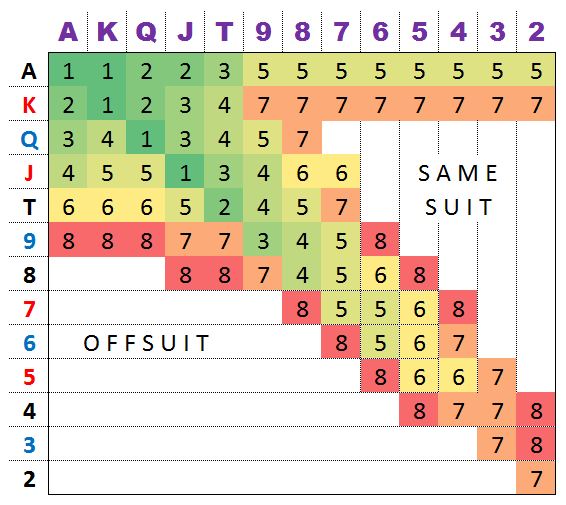
Most starting hand charts are grids showing all 169 possible two-card starting hands, color-coded to indicate which ones you should open, call, or 3-bet from various positions. They typically simplify hands into categories like “suited connectors,” “pocket pairs,” and “broadway cards.”
You can also check out our interactive starting hands chart tool — it lets you filter by position and see recommended actions in real time. But in general, imagine a big square, 13×13. Across the top, you’ve got A, K, Q, J, 10… down to 2. Down the side, same thing. Where they meet, that’s your hand. So, A and K in the top left corner is AK. If they’re suited, it’s one box; if offsuit, another. Then, each box is colored. Green for “open,” yellow for “call,” red for “3-bet,” gray for “fold.” It’s not a perfect science, but it gives you a solid baseline.
How Do I Actually Use a Starting Hand Chart?
To use a chart effectively, first identify your position at the table, then find the corresponding chart (or column on a combined chart), and finally, locate your two hole cards to see the recommended preflop action.
Okay, so you’re sitting down, the cards are dealt.
- Check Your Position: First thing, look at the dealer button. Are you UTG? On the Button? This is crucial.
- Find the Right Chart: Most good charts will have different sections or separate charts for Early, Middle, Late, and sometimes the Blinds. Pick the one for your current seat.
- Locate Your Hand: Find your two cards on the grid. Is it a pocket pair like 88? Suited like JTs? Offsuit like KQo?
- See the Action: The color or symbol in that box will tell you what the chart recommends: Open (raise), Call (limp or call a raise), 3-Bet (re-raise), or Fold.
It’s not just about memorizing, though. It’s about understanding the why. Why can you open A2s from the Button but not UTG? Because from the Button, you have a much better chance of seeing a cheap flop or stealing the blinds if everyone folds. From UTG, you’re just asking for trouble with such a weak hand.
I’ve seen some charts that are super complex, with different charts for 6-max vs 9-max, different stack sizes, even different opponent types. For a beginner, that’s just overwhelming. Start simple. My first chart was from a free poker site, maybe PokerStars School or something similar, it just had “raise,” “call,” “fold” for 9-max. It was good enough to get me going. Don’t overthink it at first.
What Are Some Common Mistakes People Make with These Charts?
The biggest mistakes when using starting hand charts are treating them as rigid rules rather than guidelines, not adjusting for table dynamics, and trying to memorize too much too fast.
Treating Charts as Gospel
Okay, so I did this for way too long. I’d have my chart up, and if it said fold, I folded. No matter what. Even if everyone else was limping, and I had KJo in late position, I’d fold because the chart for a tight-aggressive game said fold. That’s dumb! Charts are starting points. If your table is full of maniacs, you might want to tighten up your range. If everyone is super tight, you can open up a bit more, especially from late position. You gotta adapt!
Ignoring Table Dynamics (Stack Sizes, Opponent Tendencies)
This goes hand-in-hand with the first point. A chart isn’t going to tell you that the guy in the big blind is a calling station who never folds, or that the guy on your left is about to bust and is shoving any two cards. You need to pay attention. If the chart says open 78s from the Cutoff, but the player on the Button has been 3-betting every single open, maybe that 78s should be a fold this time. Or if you’re super short-stacked, your shoving range is going to be way different than your opening range. Charts are for default scenarios.
Trying to Memorize Everything at Once
Look, there are 169 starting hands. Trying to perfectly memorize every action for every position for every chart variation is just going to fry your brain. Start small. Focus on early position first, because those ranges are the tightest and simplest. Then move to middle, then late. Gradually expand your knowledge. It’s a marathon, not a sprint. I still sometimes glance at my chart for obscure hands or specific spots, even after years of playing. No shame in that!
Don’t be afraid to adjust your charts. Print one out, mark it up! If you find yourself consistently losing money with a certain hand from a certain position, even if the chart says to play it, consider folding it next time. Your own experience at your specific tables is invaluable.
Are There Different Charts for Different Game Types?
Yes, starting hand charts are definitely not one-size-fits-all; they need to be adjusted for factors like game format (cash vs. tournament), table size (6-max vs. 9-max), and effective stack depths.
- Cash Games vs. Tournaments: In cash games, stack sizes are often deeper and don’t change as much. You have more flexibility to play speculative hands (like suited connectors) because you have the implied odds to hit big and get paid. Tournaments, on the other hand, have increasing blinds and antes, and stack sizes are constantly changing. Your ranges need to be much more dynamic, especially when you get short-stacked and need to shove or re-shove.
- 6-Max vs. 9-Max: This is a huge one! A 6-max table (shorthanded) has fewer players, so positions come around faster, and ranges are generally much wider. Hands you’d fold in early position in a 9-max game (like ATo) might be an open in early position in a 6-max game. More players means tighter ranges. Fewer players means looser ranges. Simple as that.
- Stack Depth: This is probably the most overlooked factor for new players. If you have 100 big blinds (BBs), you can play differently than if you have 20 BBs. With 100 BBs, you can open KJs from middle position and be okay with calling a 3-bet to see a flop. With 20 BBs, KJs might be a fold, or even a shove, depending on the situation. Shorter stacks mean you rely more on raw hand strength and less on post-flop playability.
I remember watching an advanced GTO video (yeah, I’m a GTO nerd, even if I’m just an “ordinary” player!) where they showed ranges for 20BB, 40BB, and 100BB stacks, and they were wildly different. It blew my mind. It’s not just “open or fold,” it’s “open, but for how much and what if I get shoved on?” Poker is complex, man. If you want to see how different hands actually perform in showdowns, try running them through our Texas Hold’em odds calculator — it really puts the math into perspective.
Honestly, after years of playing, the biggest takeaway for me is that these charts are just a foundation. They give you a solid starting point so you’re not just guessing. But the real skill comes from learning when to deviate. When to loosen up, when to tighten down. When to respect someone’s 3-bet or when to fight back. It’s a never-ending learning process, and that’s what makes poker so addictive, right? You keep getting better, one hand at a time.
常见问题
Can I use a starting hand chart in live poker?
Yeah, totally! Just try to be subtle about it. You can’t have your phone out at the table, but you can definitely study it beforehand and internalize the ranges. Maybe print out a simplified version for quick reference between sessions.
How many hands should I play per hour?
It really depends on the game and table. In a tight 9-max cash game, you might only play 15-20% of your hands. In a loose 6-max game, it could be 25-30% or even more. The chart helps you stay disciplined and not overplay.
Are these charts guaranteed to make me win?
Absolutely not! No chart can guarantee wins. Poker involves variance, skill, and luck. These charts are tools to improve your preflop decision-making, which is a huge part of being profitable, but they’re not magic.
Where can I find good starting hand charts?
Many poker training sites offer free or paid charts. Upswing Poker has some great ones, as do sites like GTO Wizard for more advanced GTO-based ranges. Just search “Texas Hold’em starting hand chart” and you’ll find tons. Just remember to pick one that matches your game type (cash/tournament, 6-max/9-max).
Should I adjust my chart if I’m playing against really bad players?
YES! Absolutely. If you’re against truly awful players, you can often loosen up your range significantly, especially in late position, to exploit their mistakes (like calling too much with weak hands). But be careful not to get too wild yourself!